
Recurring expense examples and one-off costs
A monthly subscription and an annual membership both recur, even though one appears less often. A one-time equipment purchase may not recur. The distinction is about the arrangement you expect to continue, not simply whether you saw the charge in this month's statement.
Use the label for your own planning context. A replacement purchase might be one-off today while still deserving future planning. You do not need to force every irregular expense into a rigid category before you can record what is known.
| Illustrative expense | Repeats? | What to record |
|---|---|---|
| Monthly storage plan | Yes, while active | Price, cycle and next renewal |
| Annual membership | Yes, annually if renewed | Full annual charge and review date |
| One-time desk purchase | No ongoing billing arrangement | Actual amount in the purchase period |
| Regular utility bill | Yes, amount may vary | Due date and current or estimated amount |
These examples are general planning illustrations, not accounting classifications or advice about taxes. The useful question is what your own records need to show next.
Do not use recurring as another word for fixed
A bill can repeat while its amount changes. A utility payment is a familiar example. Conversely, a one-time purchase can have an exact known amount without becoming a recurring commitment. Use separate notes for frequency and whether the next amount is confirmed.
For subscriptions, a fixed-looking amount may change when a discount ends, a provider adjusts a price or you select another tier. Keep the current billing evidence near the record rather than assuming that last month's number always applies.
Annual renewals belong in the recurring list
A charge does not become one-off just because it arrives once a year. Record an annual plan with its actual cycle and date. If you compare it as a monthly equivalent, label that clearly so the small figure does not hide the full payment.
For instance, a fictional $84 annual service is equivalent to $7 a month for comparison. The provider may still charge $84 on a single date. The subscription-cost calculator helps normalize billing cycles, while a renewal calendar keeps the actual timing in view.
Give one-off costs their own place
Do not add a one-time purchase to a recurring-subscription list simply to make every expense appear together. It can distort a yearly equivalent or create a reminder for a payment that will not happen again. Keep it in the appropriate part of your personal spending record.
If a purchase starts a separate service plan, record that plan as its own commitment. The equipment price and the repeating service charge describe different things. Verify whether the recurring arrangement is actually active rather than assuming it from the purchase alone.
Use the distinction to choose the next action
For a repeating plan, check the next amount, date and whether you intend to keep it. For a one-off cost, confirm the actual charge and any remaining payment obligation. If an amount is uncertain, label it instead of allowing a precise-looking total to hide the uncertainty.
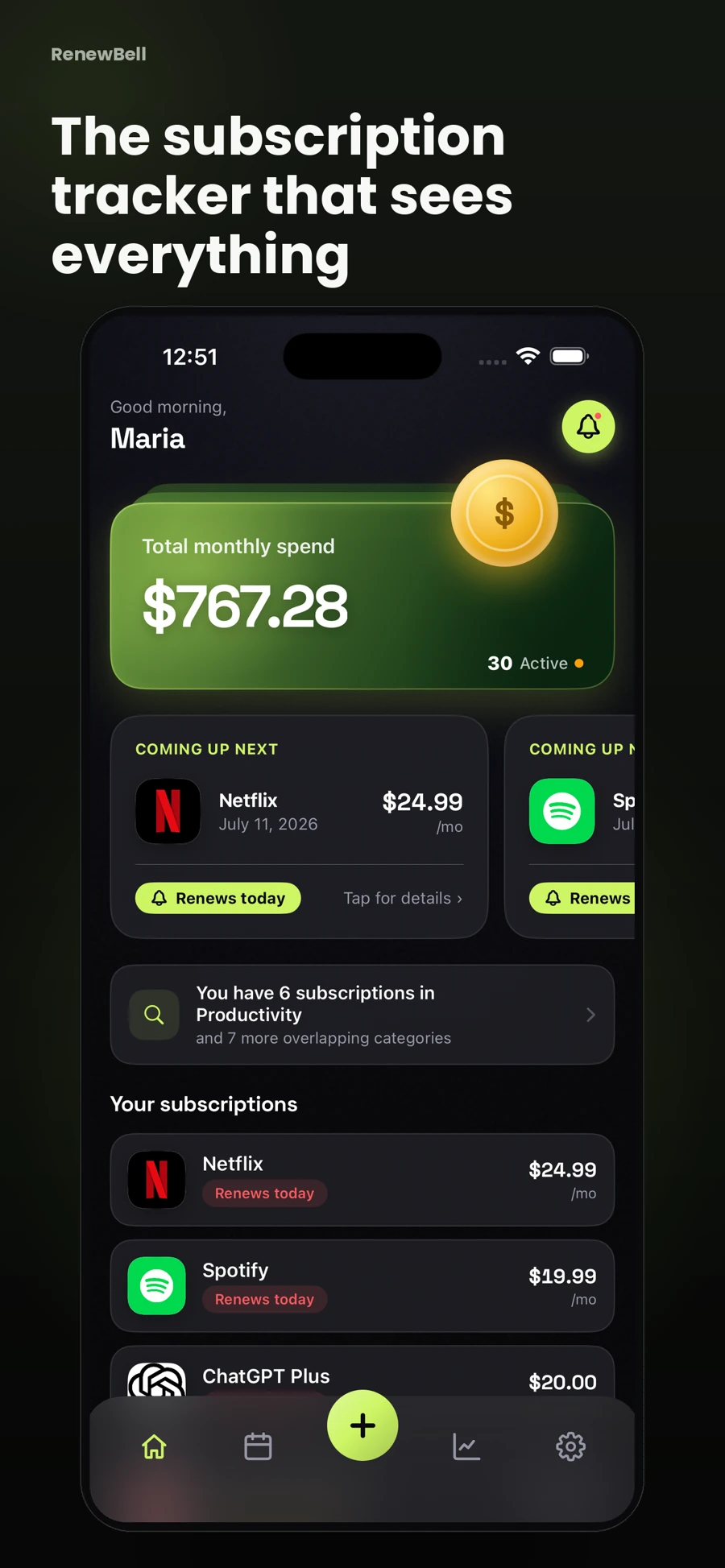
RenewBell focuses on subscriptions, bills and recurring payments you record. It does not replace a complete personal-finance account or decide which essential bills to change. Start with the monthly-bills checklist, then use the recurring-expense budgeting guide to connect the repeating list with payment timing.
App screens and worked amounts are illustrative. They do not represent current provider prices or verified customer savings.